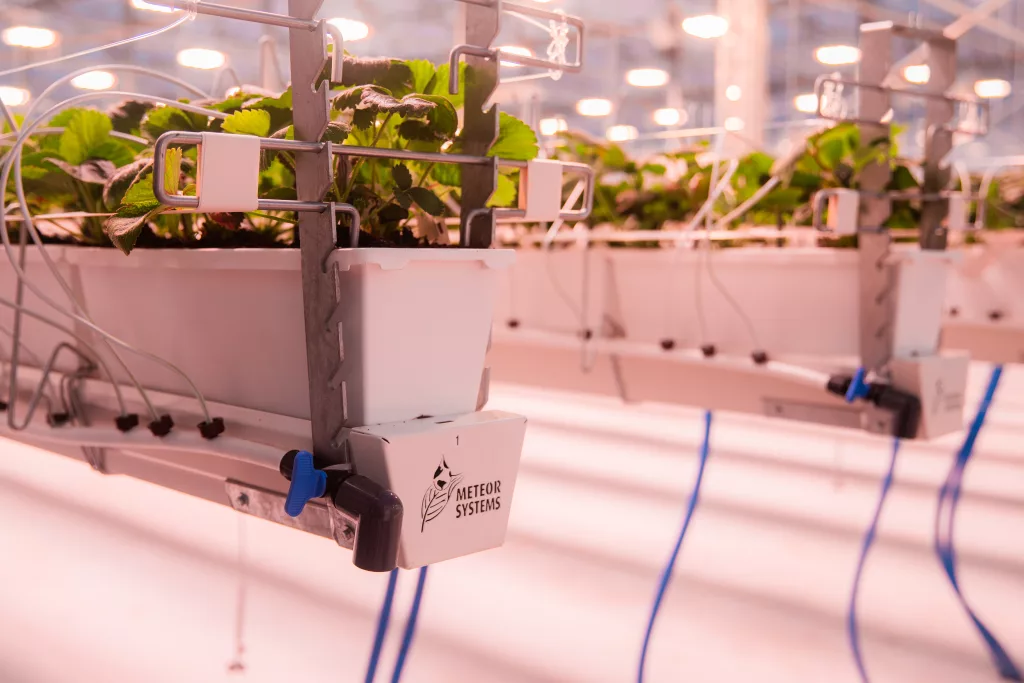
Modern greenhouse production depends on choosing the right growing system, not just the right structure. The system you grow in controls how efficiently you use water, nutrients, labor, and space, and it directly shapes the quality and volume of what you harvest.
At Harnois, we design our structures to work with the full range of growing systems used in commercial horticulture today, from simple soil beds to fully automated hydroponic lines. Whether you’re producing tomatoes, cucumbers, strawberries, leafy greens, or tree seedlings, the right system reduces disease pressure, improves uniformity, and gives you more control over your production calendar.
Why Your Growing System Matters as Much as Your Structure
A greenhouse gives your crop a stable environment. The growing system inside it determines how that environment translates into yield. Every system, no matter how it’s built, has to solve the same underlying problem: plant roots need oxygen to take up water and nutrients, and most greenhouse crops can’t get enough of it sitting in standing water. The differences between NFT, drip, substrate, and every other system below come down to how each one keeps oxygen available at the root zone while still delivering water and nutrients efficiently.
Beyond oxygen delivery, growers move away from basic soil cultivation for three main reasons:
- Disease control. Elevated and hydroponic systems keep roots away from soil-borne pathogens, cutting losses from root rot and other common diseases.
- Water and nutrient efficiency. Closed and recirculating systems deliver nutrients precisely and reuse water instead of losing it to runoff.
- Labor and space efficiency. Gutter, bench, and mobile systems raise crops to working height and let you fit more production into the same footprint.
Greenhouse Growing Systems
Nutrient Film Technique (NFT)
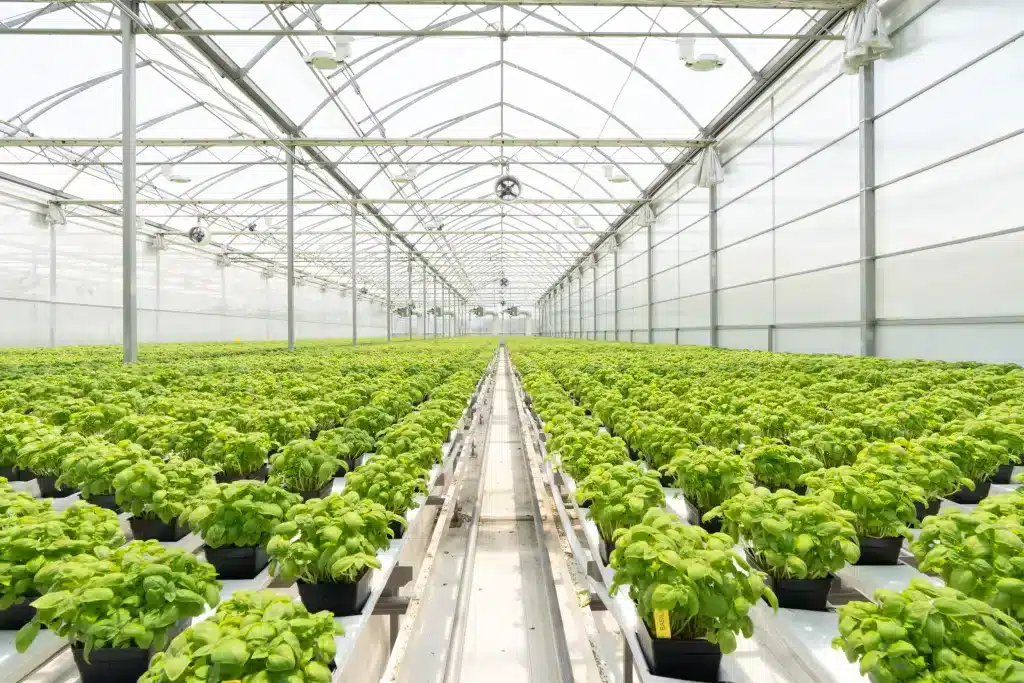
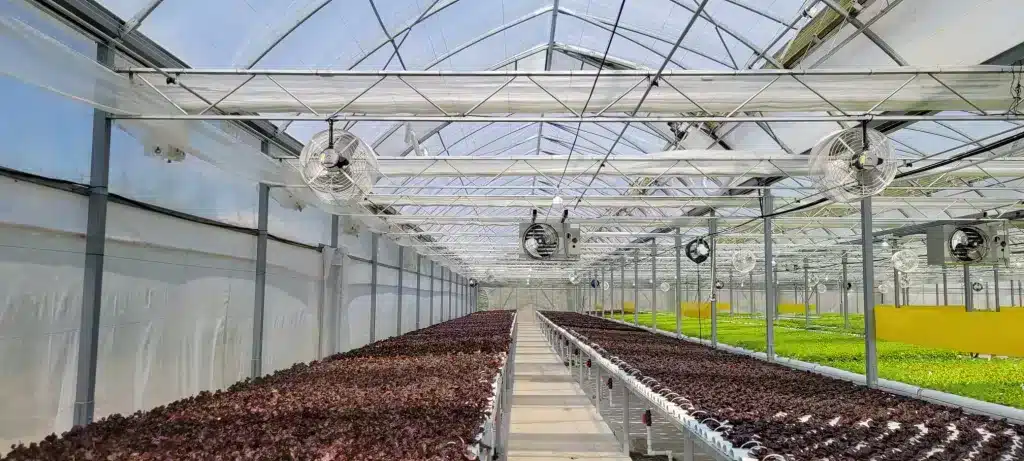
NFT circulates a thin film of nutrient solution along a slight slope, so roots stay bathed in nutrients without sitting in standing water. It’s a common choice for leafy greens and herbs, where fast turnover and consistent quality matter more than root mass. Because the system holds very little water at any given time, it responds quickly to changes in feeding schedules, but it also leaves little margin for pump downtime.
Voir le projet de technique du film nutritif pour de la fines herbes chez Gourma
Deep Water Culture (DWC)
In DWC, plant roots hang directly in an oxygenated nutrient solution, giving the plant constant access to water and nutrients with minimal handling. It suits crops with shorter cycles and simpler root systems, and it’s valued for its mechanical simplicity: fewer moving parts than drip or NFT lines. Oxygenation is the critical variable. Growers running DWC at scale need reliable aeration to avoid root suffocation in warmer water.
Raft System
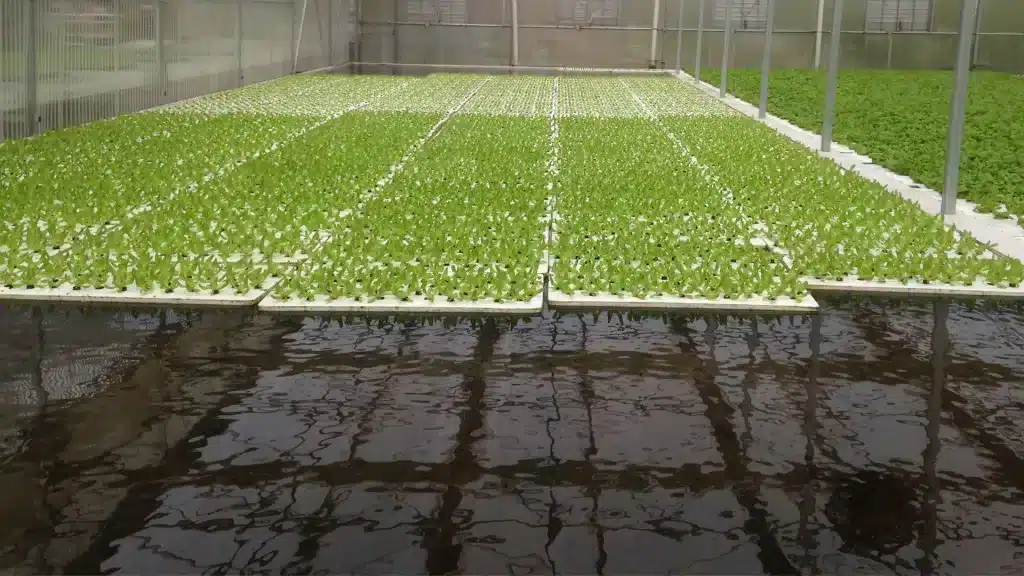
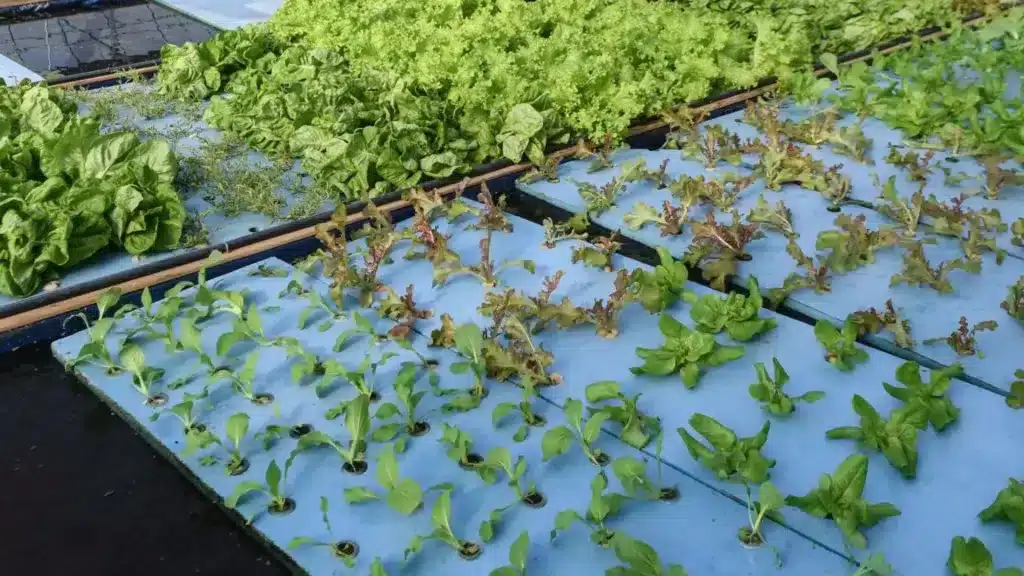
On a raft system, plants float on a shallow reservoir of nutrient solution, usually six inches to a foot deep, supported by a floating raft such as styrofoam. The solution recirculates once or twice a day rather than continuously, which keeps pumping costs low. Because the floating cover blocks oxygen from entering the solution at the surface, aeration has to be engineered into the system another way, which is the main reason raft systems are less forgiving in warm growing conditions. It’s a proven system for lettuce, herbs, and other short-cycle leafy crops.
Ebb and Flow (Flood and Drain)
Ebb and flow systems periodically flood a growing tray or bed with nutrient solution, then drain it back to a reservoir. The cycle delivers a strong dose of nutrients and oxygen at each flood, then lets roots access air between cycles. It’s a flexible, forgiving system that works well with a variety of substrates and container sizes, which makes it a common choice for growers producing mixed crops or transitioning from soil to a controlled system.
Drip Irrigation
Drip systems deliver water and nutrients directly to the base of each plant through emitters, giving growers precise, plant-by-plant control. It’s the most widely used system in commercial greenhouse produce and ornamental production because it scales easily, works with almost any substrate, and integrates directly with fertigation and climate control systems already common in Harnois structures.
Aeroponics
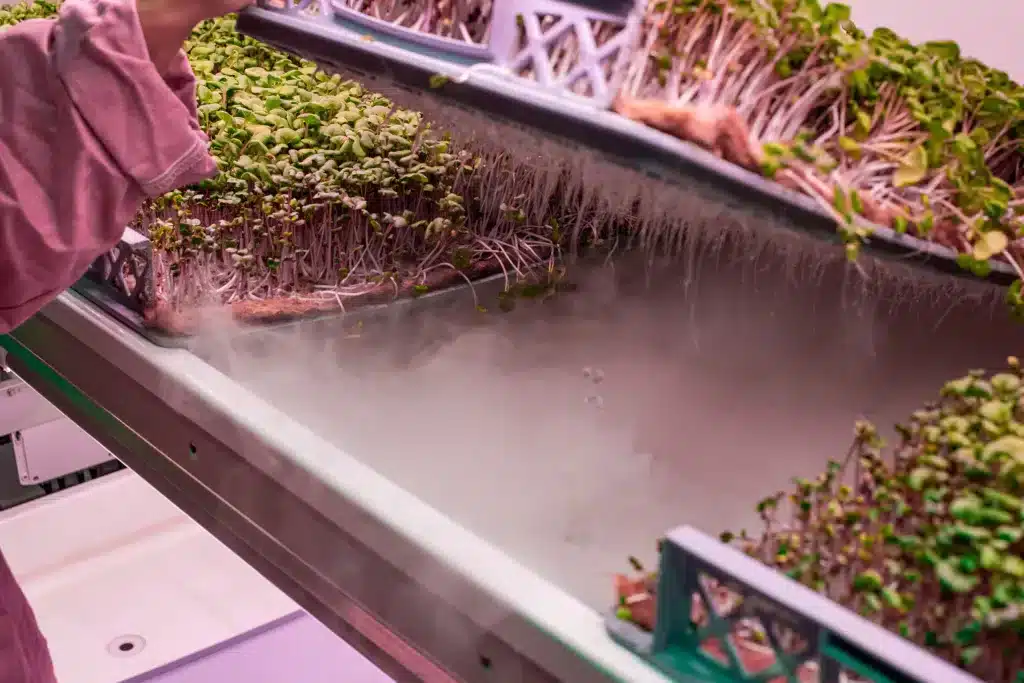
Aeroponics suspends roots in air and delivers nutrients as a fine mist, maximizing oxygen exposure to the root zone. It produces some of the fastest growth rates of any growing system, but it demands tight tolerances: a misting failure can stress a crop within hours. Aeroponics is best suited to growers with the automation and monitoring in place to manage that risk.
Aquaponics
Aquaponics pairs hydroponic crop production with fish farming, using fish waste as a nutrient source for plants and plant roots to help filter water for the fish. It’s a closed-loop, sustainability-focused system that appeals to growers looking to diversify production or market a low-input growing story, though it requires managing both a crop and a live aquaculture system side by side.
Substrate-Based Growing
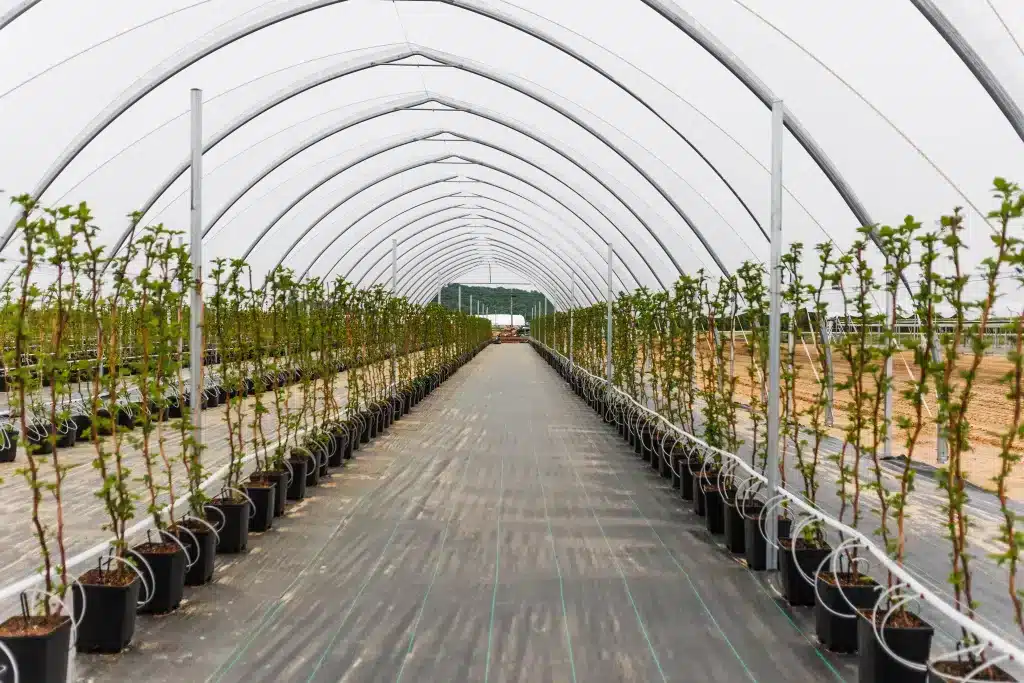
Substrate systems grow plants in a medium other than soil, while nutrients are delivered through drip or flood irrigation. The medium itself falls into two categories. Inert media like rockwool, perlite, and LECA don’t interact with the nutrient solution at all, so growers control feeding with precision through drip or fertigation. Organic media like coco coir and bark break down over time and can release or tie up nutrients as they decompose, which takes more monitoring but suits growers building toward lower-input or organic production. Most commercial tomato, pepper, and cucumber operations lean on inert substrate for its consistency and its disease and water-management advantages over open soil.
Soil-Based Greenhouse
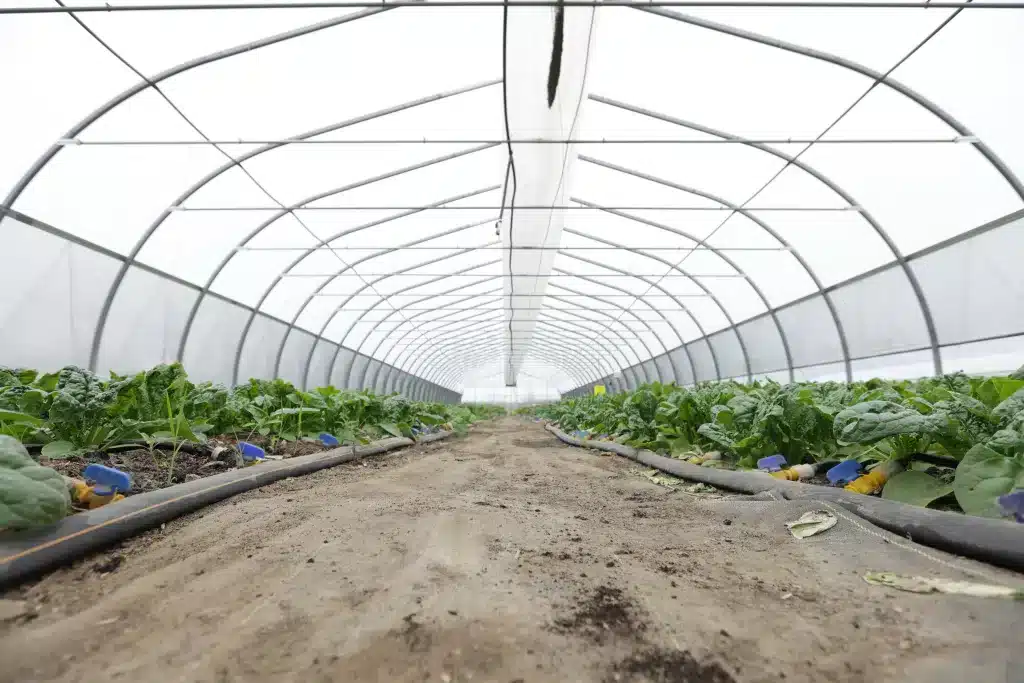
Traditional soil cultivation remains a proven, lower-input option, particularly for growers producing tree seedlings, nursery stock, or crops where in-ground planting suits the production cycle. Soil systems require less specialized equipment, but they need active management of soil health, drainage, and disease pressure over time to keep yields consistent.
Gutter, Bench, and Mobile Systems
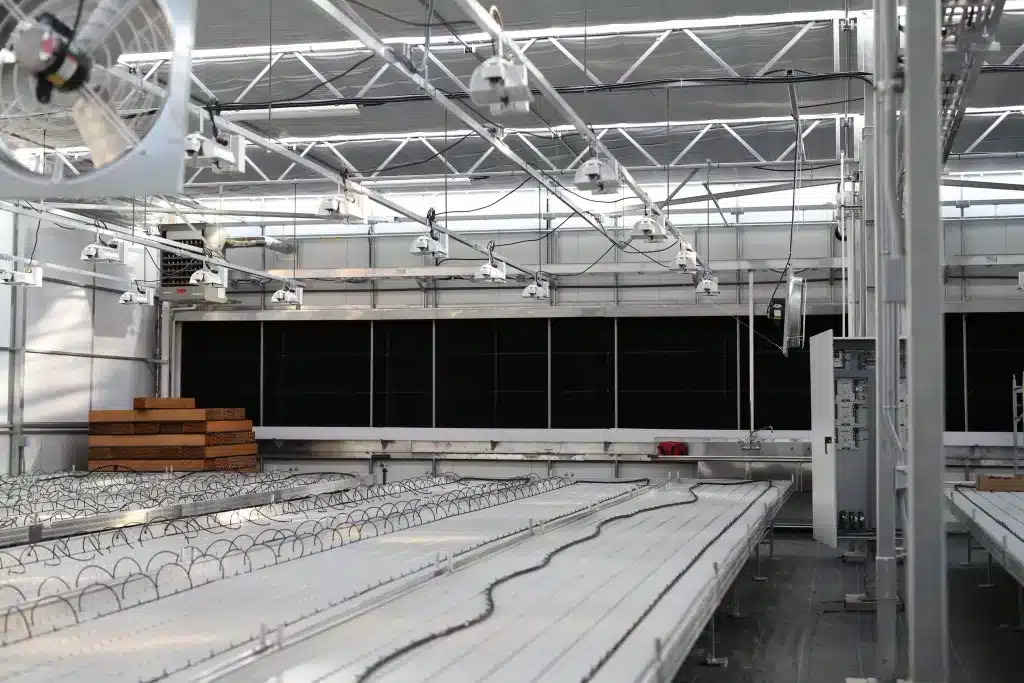
Many of the growing systems above are installed on gutters, growing tables, or mobile benches rather than directly on the greenhouse floor. Raising the crop improves aeration and drainage, makes irrigation and harvest easier on your team, and lets you move plants through the greenhouse instead of moving your team through the plants. Our growing benches are designed to support these systems inside any Harnois structure, whether you run a fixed layout or a mobile one that maximizes usable growing space.
Matched to Your Crop
The right growing system depends on what you grow:
- Fruits & vegetables: drip, substrate, and NFT systems dominate for tomatoes, cucumbers, peppers, and leafy greens.
- Nurseries & tree seedlings: soil and container-based systems remain the standard for consistent root development.
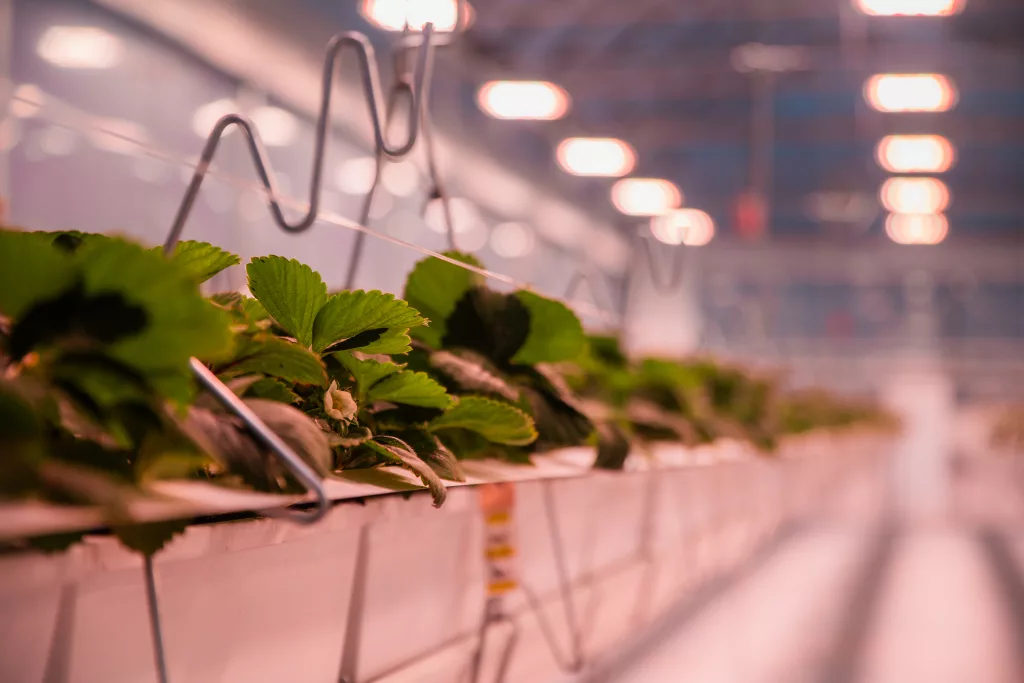
- Soft fruits: gutter-mounted substrate systems are increasingly common for strawberries, improving drainage and harvest ergonomics.
- Flowers & retail: bench and container systems give growers flexibility across changing crop mixes.
Not sure which growing system fits your operation? Our team can help you match a system to your crop, climate, and production goals.