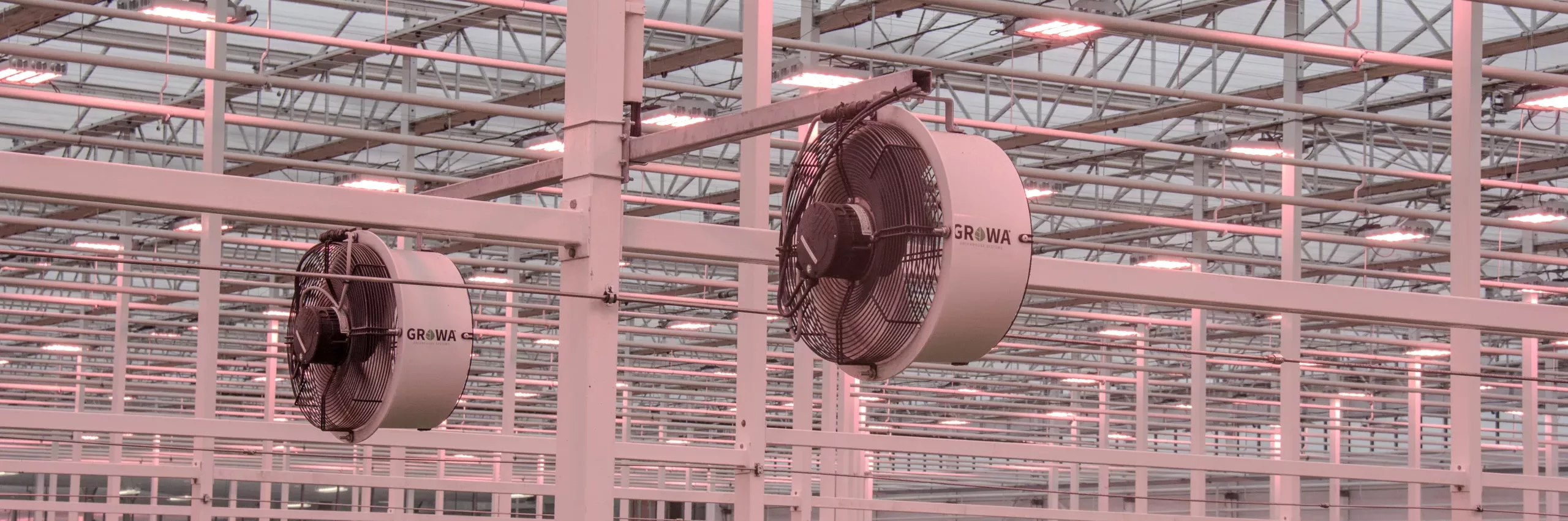
Proper commercial greenhouse ventilation is one of the most important — and often overlooked — aspects of a successful growing operation. A well-designed system ensures healthy crop development, improves yield, and protects your structure from long-term damage caused by excessive heat and humidity.
In this guide, we’ll walk you through the key factors to consider when choosing a commercial greenhouse ventilation system, compare natural and mechanical approaches, and share practical tips to help you get the most out of your setup.
Why Ventilation Matters in Greenhouses
Ventilation isn’t just about keeping your greenhouse cool. It’s a critical part of managing the entire growing environment. An effective commercial greenhouse ventilation system helps:
- Control temperature and humidity to prevent heat stress and fungal diseases
- Prevent the buildup of plant pathogens and pests caused by stagnant, moist air
- Encourage strong plant growth by continuously replenishing CO₂ levels
- Circulate fresh air to eliminate dead zones and reduce condensation on surfaces
Whether you’re growing leafy greens, ornamentals, or high-value crops, proper airflow directly impacts plant health, operational efficiency, and profitability. Getting your ventilation right from the start saves you significant costs down the line.
Ventilation isn’t just about keeping your greenhouse cool. It’s a critical part of managing the entire growing environment. An effective commercial greenhouse ventilation system helps:
- Control temperature and humidity to prevent heat stress and fungal diseases
- Prevent the buildup of plant pathogens and pests caused by stagnant, moist air
- Encourage strong plant growth by continuously replenishing CO₂ levels
- Circulate fresh air to eliminate dead zones and reduce condensation on surfaces
Whether you’re growing leafy greens, ornamentals, or high-value crops, proper airflow directly impacts plant health, operational efficiency, and profitability. Getting your ventilation right from the start saves you significant costs down the line.
Natural vs. Mechanical : Which Is Right for You?
There’s no one-size-fits-all solution. The right system depends on your location, your greenhouse structure, and the crops you grow.
Natural Greenhouse Ventilation
Natural ventilation uses roof vents, side vents, and thermal buoyancy to move air through the structure. It relies on the stack effect — warm air rises and exits through ridge vents while cooler air enters through side openings — to create passive airflow.
Best for: Regions with mild, consistent climates and steady wind patterns.
Pros:
- Energy-efficient and eco-friendly — no electricity required for airflow
- Lower upfront installation and operational costs
- Simple to maintain with fewer mechanical components
Cons:
- Limited control during extreme heat or calm weather conditions
- Performance depends heavily on outdoor climate and wind direction
- May require larger vent openings to achieve adequate airflow in warm months
For growers exploring natural ventilation, structures like our freestanding Ovaltech greenhouse are designed with gothic peak geometry and optimized under-gutter clearance to maximize passive airflow and temperature stability.
Mechanical Greenhouse Ventilation
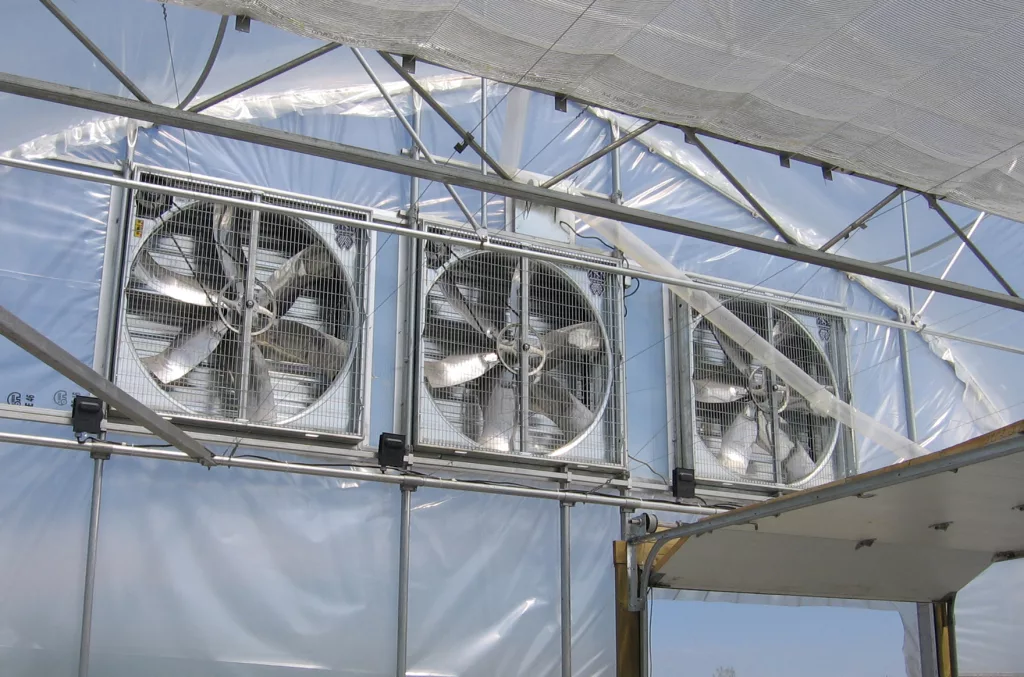
Mechanical systems use exhaust fans, intake vents, and horizontal airflow (HAF) circulation fans to actively regulate air movement. They’re especially valuable in larger operations, multi-bay structures, and regions with hot or unpredictable summers.
Best for: Large commercial operations, climate-controlled growing, and year-round production.
Pros:
- Consistent, reliable performance regardless of outdoor conditions
- Precise control over airflow rate, temperature, and humidity levels
- Fully compatible with automated climate control and monitoring systems
Cons:
- Higher upfront installation costs and ongoing energy consumption
- Requires regular maintenance of fans, motors, and intake screens
Our gutter-connected Luminosa greenhouse supports both roof vents and mechanical ventilation with cooling pads, offering growers the flexibility to combine passive and active systems based on seasonal needs.
Matching Your Ventilation Strategy to Your Greenhouse Type
Not all greenhouse structures ventilate the same way. Your strategy should be tailored to your specific setup:
Gutter-Connected Greenhouses
Multi-bay gutter-connected structures typically benefit from mechanical systems because natural airflow has difficulty penetrating uniformly across multiple bays. Exhaust fans placed on the end walls, combined with evaporative cooling pads on the opposite side, create a consistent cross-ventilation pattern.
Freestanding Greenhouses
Freestanding structures are well-suited for natural ventilation, especially when equipped with ridge vents, side roll-up panels, and mid-roof vent options. The single-bay design allows wind to pass through the structure more effectively.
High Tunnels and Hoop Houses
High tunnel greenhouses typically rely on roll-up sidewalls for passive ventilation. The TunnelPro Plus, for example, offers full or partial side roll-up options that can be opened manually or motorized to respond quickly to temperature changes. Combining roll-up sides with shading screens adds an extra layer of temperature management during peak summer heat.
Smart Ventilation Technologies for Commercial Greenhouses
Modern commercial growing operations are increasingly adopting automated climate management to improve consistency and reduce labor. Consider integrating these technologies into your ventilation system:
- Automated vent controls: Sensors continuously monitor temperature, humidity, and CO₂ levels, adjusting vents and fan speeds in real time without manual intervention.
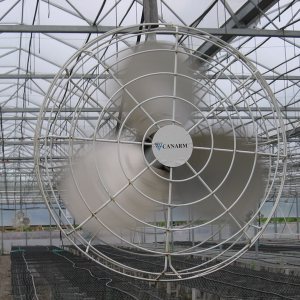
- Energy-efficient circulation fans: Strategically placed HAF fans prevent air stratification, reduce humidity pockets, and lower overall cooling demands — without the energy cost of full exhaust fan operation.
- Integrated climate control systems: Combining ventilation with heating, shading, and irrigation creates a holistic growing environment with far greater predictability. At Harnois, our advanced greenhouse equipment integrates seamlessly with climate control systems to give growers precise command over every variable.
For growers targeting maximum efficiency, the Vermax glass greenhouse features an AI-driven micro-climate management system and Nearly Zero Energy Building (NZEB) principles — representing the cutting edge of integrated climate and ventilation design.
Maintenance Tips to Keep Your System Running Efficiently
Even the best commercial greenhouse ventilation system will underperform without regular upkeep. Keep these practices in mind:
- Inspect fans, vents, and motors at least twice a year for wear, corrosion, or mechanical blockages
- Clean intake screens, louvers, and evaporative cooling pads regularly to ensure unobstructed airflow
- Verify that automated sensors and thermostats are accurately calibrated — a sensor drift of just a few degrees can throw off your entire climate program
- Adjust ventilation settings seasonally: summer setpoints differ significantly from spring or fall requirements
- Check belt tension and lubrication on motorized vent systems to prevent costly downtime during peak growing periods
A well-maintained system runs longer, costs less to operate, and protects your crop investment through consistent environmental control.