A Billion-Dollar Experiment Goes Dark
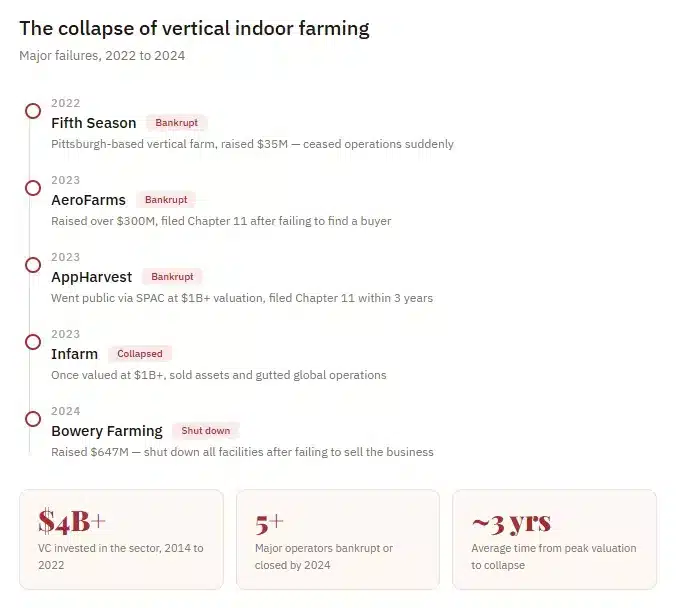
The poly greenhouse vs indoor vertical farming debate should have been settled years ago. AppHarvest. AeroFarms. Fifth Season. Bowery Farming. These names were once plastered across agriculture trade publications as the future of food. Today, most of them are bankrupt, shuttered, or desperate for a lifeline. The indoor vertical farming sector, flush with billions in venture capital through the 2010s and early 2020s, has hit a wall so hard it should have been obvious from the start.
This is not a story about good ideas executed poorly. It is a story about a fundamental misreading of how food production economics work and a cautionary tale about what happens when technology enthusiasm outpaces agronomic reality.
Meanwhile, greenhouses have continued to grow, steadily, profitably, and without the drama. That contrast is not a coincidence. It reflects something deeper about where controlled environment agriculture actually makes economic sense, and where it doesn’t.
The Energy Problem Nobody Wanted to Talk About
The core promise of vertical indoor farming was seductive: grow crops anywhere, year-round, with no dependence on weather, soil, or geography. Stack plants in layers, bathe them in LED light, control every variable. Sounds revolutionary. The problem is that plants need photons to grow, an enormous, non-negotiable quantity of them, and replacing the sun costs money that simple arithmetic makes ruinous.
The sun is free. Electricity is not.
A commercial greenhouse leverages free solar energy for the majority of its lighting needs, supplementing with artificial light only when and where necessary. A fully indoor vertical farm must generate 100% of its photon budget from the grid. At commercial growing intensities, energy bills for indoor farms routinely represent 25 to 45% of total operating costs, before labor, nutrients, packaging, or debt service.
When energy prices spiked in 2021 to 2023, indoor farms didn’t just see margins compress. Many saw unit economics invert entirely. They were paying more to produce a head of lettuce than they could sell it for. No amount of operational excellence fixes that equation.
Indoor vertical farms use 50 to 100x more electricity per kg of produce than greenhouses. A greenhouse uses the sun for 70 to 90% of its light, dramatically reducing this burden. Indoor farm produce must sell at a significant premium, a premium most consumers won’t pay consistently. LED technology improvements have not kept pace with the cost gap.
The VC Mirage: When Capital Masks Unit Economics
Here is what venture capital can do: it can fund losses for years while a company scales, hires, iterates, and waits for the model to work. Here is what venture capital cannot do: it cannot permanently subsidize the cost of electricity, labor, or capital equipment in a low-margin commodity food business.
Indoor farming attracted capital because it told a compelling story, food security, climate resilience, local supply chains, and because investors in 2019 were willing to believe that technology could disrupt any industry. The category raised over $4 billion globally between 2014 and 2022. Then interest rates rose, growth-at-all-costs fell out of fashion, and suddenly investors wanted to see a path to profitability. That path, in most cases, didn’t exist.
Scale made things worse, not better.
In most technology businesses, scale drives down unit costs. Software has near-zero marginal cost. Data gets cheaper to store as you buy more of it. Indoor farming works in reverse: the bigger the facility, the bigger the electricity bill, the bigger the labor force, the bigger the HVAC system that must run 24/7. Fixed costs scale with square footage in an industry where the product sells for dollars per pound.
This is what growers with decades of greenhouse experience understood intuitively that Silicon Valley did not: agriculture is not software. You cannot iterate your way out of plant biology.
What Greenhouses Get Right
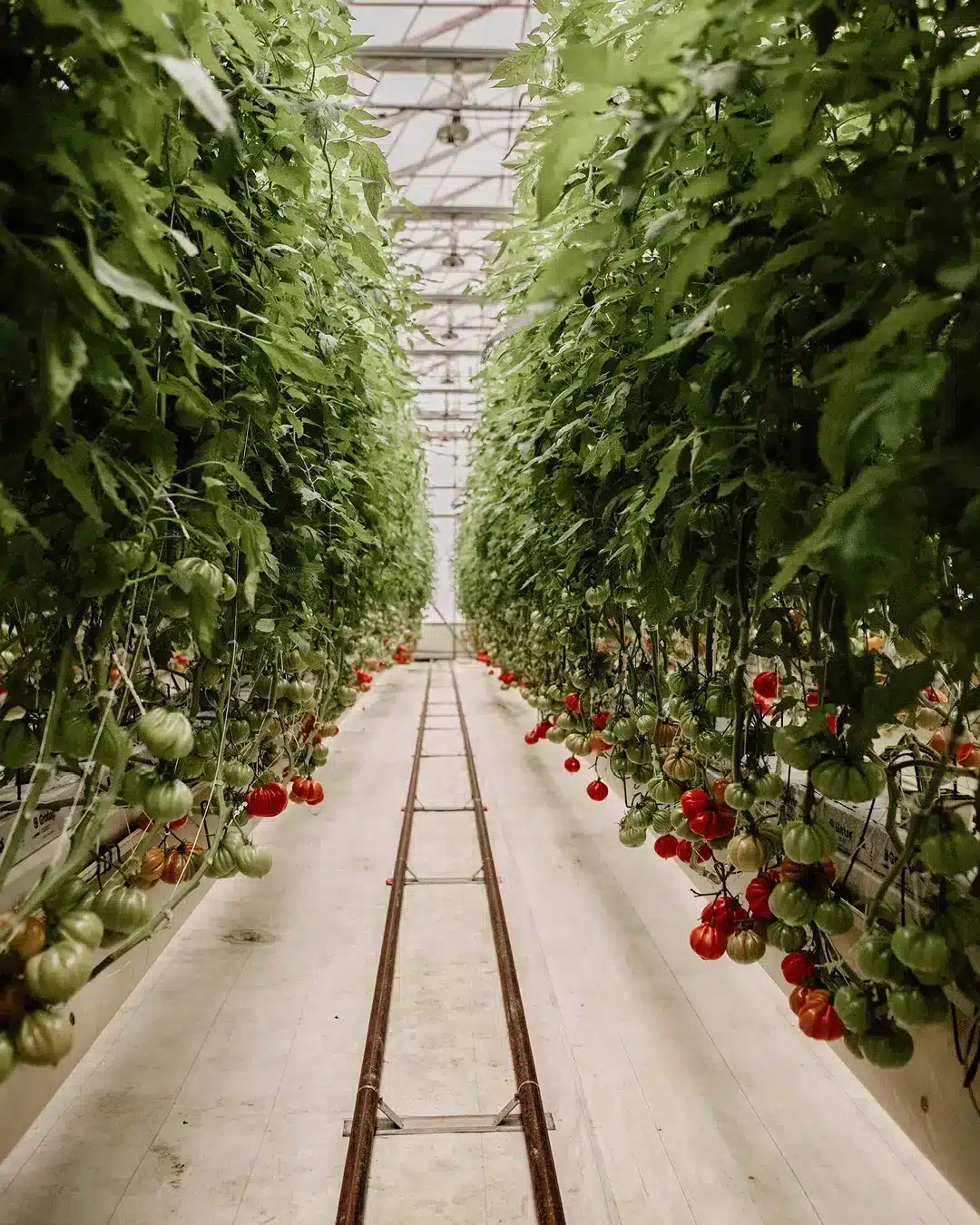
Greenhouses are not new technology. They are not exciting. They do not generate breathless TechCrunch coverage. What they do is work, reliably, profitably, and at scale, because they are built on a sound principle: use the sun, and manage what you can’t control.
The hybrid advantage
A modern commercial greenhouse is a sophisticated piece of infrastructure. It captures and transmits solar radiation efficiently while allowing operators to supplement light, regulate temperature, manage humidity, deliver nutrients precisely, and protect crops from pests and weather. It harnesses nature’s free energy while removing its worst risks.
The result is a production system with unit economics that actually work. Energy costs in a well-designed greenhouse are a fraction of those in an indoor farm. Labor is more manageable. Capital requirements, while significant, are proportional to real output. And critically, greenhouses can grow a far wider range of crops: tomatoes, peppers, cucumbers, herbs, flowers, cannabis, not just the leafy greens that indoor farms have largely been confined to.
Geography matters and greenhouses don't pretend otherwise.
One of the more disingenuous claims in indoor farming marketing is that geography becomes irrelevant. You can grow anywhere. A warehouse in New Jersey can produce lettuce as efficiently as a field in California. This is technically true and economically misleading. Yes, you can grow lettuce in a converted warehouse in January. The question is whether you can do it at a cost that makes sense and overwhelmingly, you cannot.
Greenhouses, by contrast, are honest about geography. The best greenhouse regions combine adequate solar radiation, reasonable land costs, proximity to markets, and a workforce with agricultural knowledge. Siting a greenhouse well is half the battle, and experienced greenhouse builders know this.
The Market Reality Check
Let’s talk about the consumer. Indoor farming advocates built their business models on the assumption that shoppers would pay a substantial premium for local, pesticide-free, year-round produce. In focus groups and surveys, consumers said they would. At the checkout counter, they often didn’t.
Grocery retail is a punishing environment for premium products. A head of lettuce grown locally in a vertical farm competing against a California field-grown product at half the price is fighting a losing battle with the average family budget. The market for genuinely premium produce exists, but it is a niche, not a mass market, and most indoor farm business plans required mass-market volume to cover their fixed costs.
Greenhouse growers already solved this problem.
Commercial greenhouse tomatoes and cucumbers have successfully commanded a modest premium over field-grown alternatives for decades. Why? Because the quality difference is visible and consistent. A greenhouse tomato sold in February doesn’t need to compete on ideology. It competes on taste, color, and firmness against a mealy, shipped-from-Florida alternative. That’s a winnable battle.
Indoor farms tried to win on story. Greenhouse growers win on product. The distinction matters enormously.
The Real Alternatives: Poly Greenhouses and the Gutter-Connected Model
Here is where the conversation usually gets too binary. Critics of indoor farming either defend the failed VC model or point vaguely toward “greenhouses” as the answer, as if all greenhouses are the same. They are not. And for growers serious about making a capital decision, the differences matter enormously.
The most overlooked alternative in this entire debate is the polyethylene greenhouse, specifically the gutter-connected poly greenhouse at commercial scale. It is not as photogenic as a glass Venlo range. It does not make it into the architectural renders that win awards. But it is, dollar for dollar, one of the most economically defensible structures in commercial agriculture today.
What a poly greenhouse actually is
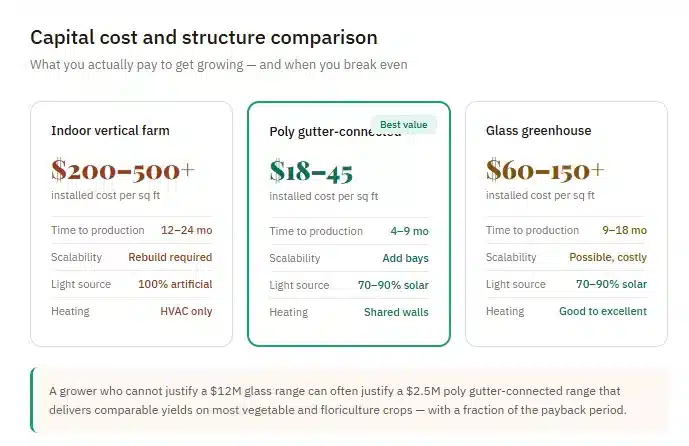
A polyethylene greenhouse uses one or multiple layers of UV-treated poly film over a galvanized steel frame. Modern double-layer inflated poly film provides excellent insulation, diffuses light to reduce crop stress, and costs a fraction of glass per square foot installed. These are not hobby hoop houses. Commercial-grade poly greenhouses are engineered structures designed to handle wind, snow loads, and decades of continuous operation in demanding climates.
The economics are straightforward: lower capital cost per square foot means faster payback, lower breakeven production volume, and more flexibility to scale incrementally. A grower who can’t justify a $12M glass range can absolutely justify a $2.5M poly range that produces comparable crop yields on most vegetable and flower crops.
The gutter-connected advantage and why it changes the calculation entirely
A single freestanding poly tunnel is a seasonal production tool. A gutter-connected poly greenhouse range is a commercial operation. The distinction is not cosmetic. It is structural, operational, and economic.
In a gutter-connected configuration, multiple greenhouse bays share common sidewalls and gutters, creating a single continuous growing environment that spans tens of thousands or hundreds of thousands of square feet. This design eliminates the dead space, heat loss, and labor inefficiency of managing many separate structures. You get the low capital cost of poly film with the operational efficiency of a large integrated facility.
The thermal performance is another underappreciated advantage. Gutter-connected ranges have far less exposed exterior surface area relative to their growing footprint than freestanding tunnels. In cold climates, this translates directly to heating costs, the single largest variable operating expense for northern greenhouse operations. A well-configured gutter-connected poly range in Quebec or Minnesota can achieve heating efficiency that rivals glass structures at a fraction of the construction investment.
The right structure for the right operation.
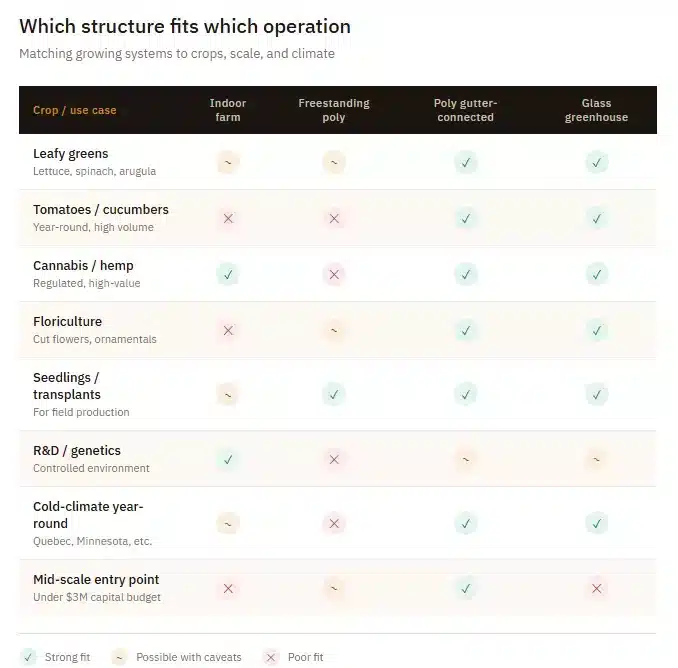
None of this is to say that glass greenhouses are wrong, or that freestanding tunnels have no place. The honest answer is that the right structure depends on the grower’s goals, geography, crops, and capital position. A seedling nursery operation with seasonal demand and modest capital may be perfectly served by a few freestanding poly tunnels. A commercial tomato or cannabis operation targeting year-round production at volume needs gutter-connected infrastructure, whether poly or glass.
What the industry needs to stop doing is treating “greenhouse” as a monolith. A gutter-connected poly range producing year-round tomatoes in a northern climate is a fundamentally different investment proposition from a glass Venlo range, a single-layer seasonal tunnel, or a converted warehouse full of LED racks. Conflating them obscures the real decision growers face and it has allowed indoor farming advocates to argue against a strawman version of greenhouse production for years.
The entry point into commercial greenhouse production is far more accessible than the industry’s high-end projects suggest. Poly gutter-connected infrastructure has made viable what was once considered too capital-intensive for mid-scale producers. That accessibility is one of the most important structural advantages greenhouses hold over vertical farms and it is one the industry has not communicated loudly enough.
Where Does Indoor Farming Actually Belong?
This is not an argument that indoor farming has no future. It is an argument that indoor farming advocates vastly overstated how large and how fast that future would arrive, and built capital structures that reflected their optimism rather than agronomic reality.
There are genuine niches where fully controlled indoor environments make sense: high-value pharmaceutical and nutraceutical crops, research and genetics operations, urban centers with exceptional real estate constraints, and specialized crops where the premium commanded is large enough to offset energy costs. Cannabis has been the clearest real-world demonstration, a crop where the value per square foot can justify the operating economics of indoor production.
But commodity vegetables? Commodity herbs? Competing in the grocery aisle at scale? The numbers have never worked, and the wave of bankruptcies we have seen is not a failure of execution. It is the market delivering a verdict on the premise itself
Back to Basics. And That's a Good Thing.
The indoor farming correction, painful as it has been for those who invested and lost, may ultimately be healthy for the broader controlled environment agriculture sector. It is redirecting capital and talent toward models that actually work and it is reinforcing a truth that experienced growers never forgot.
Growing food profitably requires humility. It requires working with biology, not against it. It requires respect for the economics of commodity markets, for the unmatched scale of the sun, and for the compounding advantage of decades of accumulated agronomic knowledge.
Greenhouses are not the old way. They are the right way. They represent a partnership between human ingenuity and natural systems and that, ultimately, is the only kind of partnership that scales.