

In 1973, a single project changed the course of commercial greenhouse growing in Canada — and beyond. Rolland Harnois, founder of Harnois Industries Inc., designed and built the first gothic arch-style, gutter-connected greenhouse complex ever constructed in the country. At 45,000 ft², it was not only the largest of its kind in Canada at the time, but also the first structure specifically engineered for regions with heavy snowfall — a challenge most greenhouse manufacturers had never faced head-on.
This is the story of that breakthrough, and why the gothic arch design remains a cornerstone of commercial greenhouse structures to this day.
1973: A Historic Year for Harnois Industries Inc.
The project was built on the site of Jardins Lanaudière Inc., nestled within a wooded location in Notre-Dame-de-Lourdes, Quebec. The site presented real logistical challenges: landlocked terrain, dense forest surroundings, and a Canadian winter that would soon prove to be a true stress test.
Rolland Harnois did not work alone. The success of the project depended on a team of dedicated collaborators:
- Mathias Asselin — Site Manager
- Claude Harnois — Heating Expert
- Robert Boucher — Site Operations
- Normand Tellier — Culture Manager and Site Operator
Together, they pulled off a feat that had never been attempted at that scale in Canada. The first winter was, by all accounts, a difficult proving ground — but Harnois and his team met every challenge. The complex stood, performed, and produced.
The first commercial crop was greenhouse tomatoes, marketed under the brand “Gusta” — a product proudly grown in Quebec, sold to local markets.
Why the Gothic Arch-Style Greenhouse Outperforms Other Designs
The gothic arch profile was not chosen for aesthetics. It was chosen for performance under load.
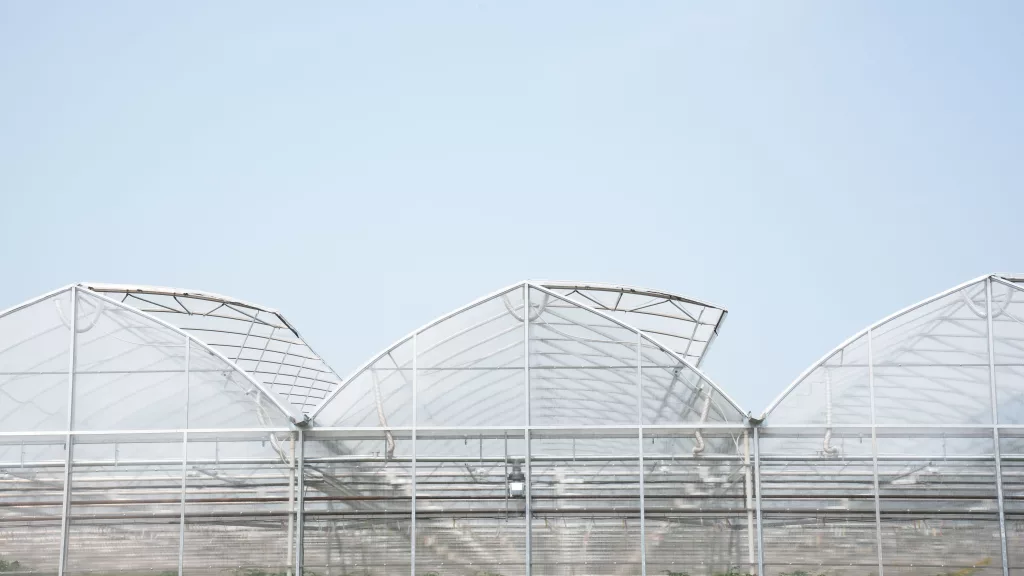
The steep, pointed slope of a gothic arch roof is uniquely effective at shedding snow. In regions like Quebec, where seasonal snowfall can easily exceed manageable thresholds for flat or low-pitch roofs, the angle of a gothic arch allows snow to slide off naturally, reducing the structural stress on the frame and the covering film. This was, in 1973, a genuine engineering innovation adapted to the Canadian climate.
Beyond snow management, the gothic arch delivers measurable advantages for growers:
- Superior light transmission: The optimized roof angle, combined with high-performance polyethylene film, delivers up to 90–91% light transmission — critical for year-round crop production.
- Better air volume and climate stability: The taller peak increases internal air volume, helping maintain more stable temperatures and reducing condensation on the film surface.
- Efficient water and snow runoff: The steep slope minimizes standing water and ice accumulation, extending the lifespan of the covering.
These benefits, first proven at Jardins Lanaudière in 1973, are still the engineering foundation of Harnois’ current gutter-connected greenhouse lineup, including the Luminosa — the company’s flagship multi-bay, gothic arch poly greenhouse designed for large-scale commercial production.
Gothic Arch-Style Gutter-Connected Greenhouses: Built to Scale
What made the 1973 complex particularly forward-thinking was not just the arch shape — it was the gutter-connected configuration. Rather than building isolated freestanding structures, Rolland Harnois linked multiple gothic arch bays under a single continuous gutter system. This allowed:
- A massive 45,000 ft² of growing area under unified climate control
- Elimination of exterior walls between bays, reducing heat loss and material costs
- Unobstructed interior movement for workers, machinery, and equipment
- A scalable layout that could grow with the operation
This plug-and-play approach to greenhouse expansion remains one of the defining advantages of gutter-connected greenhouses today. A grower can start with four bays and expand to twenty without rebuilding from scratch — the same modularity Rolland Harnois demonstrated over 50 years ago.
From One Complex to 20,000+ Projects Worldwide
The success at Jardins Lanaudière was quickly confirmed by the market. The Gusta tomatoes sold well, the structure performed through multiple harsh Quebec winters, and Harnois Industries’ reputation as a greenhouse innovator was established.
What started as a single 45,000 ft² complex in Notre-Dame-de-Lourdes has since grown into a company with more than 20,000 completed greenhouse projects across international markets. Founded in 1965, Harnois Industries has spent over six decades refining the same core principles Rolland Harnois applied in 1973: engineering that fits the climate, structures that support the grower, and solutions built to last.
Today, the Harnois commercial greenhouse range includes high tunnels, freestanding poly greenhouses, Venlo glass structures, and advanced gutter-connected systems — all carrying the genetic imprint of that original gothic arch innovation.
The Gothic Arch Today: Built on Oval Steel, Proven in the Field
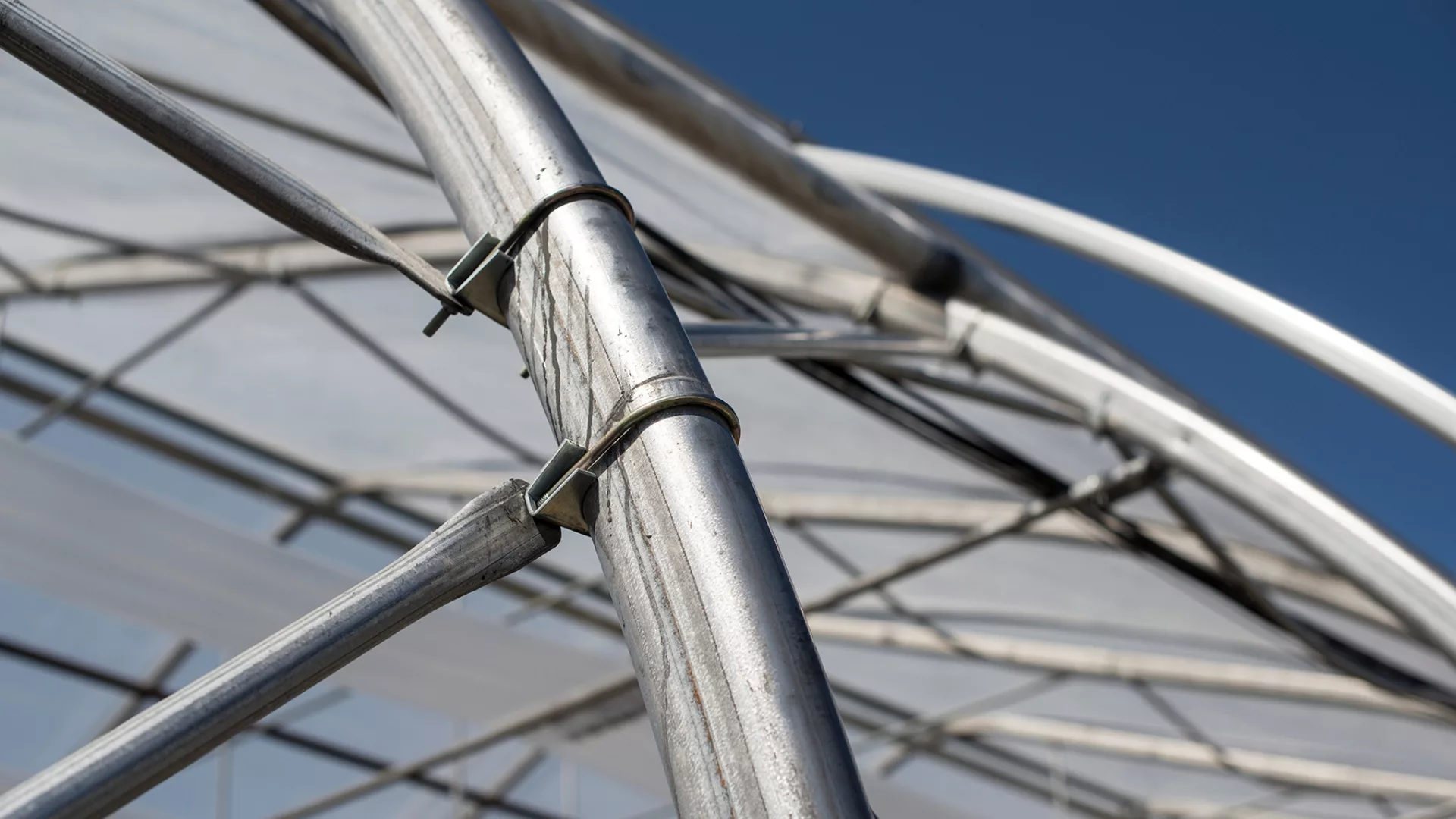
Modern Harnois gothic arch structures like the Ovaltech and Luminosa series go far beyond the 1973 original. The company’s exclusive oval steel tube technology — manufactured from 50 ksi certified structural steel — is up to 3.9× stronger than standard round tubing of the same size. Fewer arches are needed, shading is reduced, installation is faster, and the structure handles snow loads up to 622 kg/m² (127 psf) and wind speeds up to 250 km/h (155 mph).
The gothic peak design, combined with Galvalume-coated oval arches and double polyethylene film, creates a growing environment that is warmer, brighter, and more energy-efficient than competing designs. Growers who adopt the gothic arch configuration consistently report better crop quality, longer cover lifespan, and lower operating costs compared to round-arch alternatives.
For growers evaluating greenhouse heating systems and climate control options, the gothic arch’s inherent air volume advantage also reduces the energy demand required to maintain stable temperatures — a benefit Rolland Harnois understood in principle even in 1973.
A Legacy Built in Quebec, Grown Across the World
The story of the first gothic arch-style greenhouse in Canada is ultimately a story about solving a real problem: how do you build a large-scale commercial greenhouse that survives a Canadian winter, maximizes growing space, and remains financially viable? Rolland Harnois answered that question in 1973 with 45,000 ft² of steel and polyethylene in Notre-Dame-de-Lourdes.
Over 50 years later, that answer still holds. The gothic arch-style, gutter-connected greenhouse remains the most widely adopted configuration for commercial poly greenhouse production in cold climates — in Canada, the United States, and across international markets where Harnois structures stand.
Harnois Industries has been promoting local production and supporting growers for over 60 years. If you are ready to build on that legacy, request a quote and speak with a Harnois greenhouse specialist.
Article published: November 16, 2020 | Last updated: March 25, 2026 Author: Laurence Cauchon, Harnois Industries Inc.
