
Share

Table of content

Commercial Greenhouse Buying Guide for Professional Growers

Investing in a commercial greenhouse is a strategic decision that directly impacts crop performance, operating costs, and long-term business stability. Professional growers are not simply purchasing a structure, they are selecting a production system that must perform reliably under real-world climate conditions, meet regulatory requirements, and adapt as operations scale. This commercial greenhouse buying commercial greenhouse buying guide is designed to help growers evaluate the most important factors before investing, from structural design and manufacturer selection to costs, automation readiness, permitting, and regional considerations across North America.

With decades of experience engineering greenhouse structures for demanding climates, Harnois approaches greenhouse design as a long-term partnership rather than a one-time transaction. The insights in this commercial greenhouse buying guide reflect proven design principles, real-world grower priorities, and the practical realities of operating commercial greenhouses in Canada, the United States, and Mexico; where durability, efficiency, and support matter as much as the structure itself.

As greenhouse projects become larger and more complex, commercial growers increasingly judge manufacturers not only on the structures they sell but also on how they conduct the sales process, the level of support they provide, and their ability to adapt to regional realities. To meet these growing expectations, manufacturers can take practical steps such as implementing detailed consultative processes during sales to tailor solutions specific to each grower’s needs. This could begin with conducting thorough needs assessments and hosting initial consultation meetings to identify each grower’s goals and constraints. Another approach is to establish a dedicated post-sale support team that offers both technical assistance and educational resources. This team might include experienced agronomists and technical specialists, who are readily available to address issues as they arise. These actions strongly influence purchasing decisions, especially for first-time buyers or multi-site operators.

Cost Transparency and Budget Planning

Growers expect manufacturers to operate with a high degree of openness and technical credibility from the first conversation onward. This starts with transparent pricing and realistic project scoping. Rather than presenting a single bundled price, effective manufacturers break down costs into structure, covering, systems, readiness, and site. This helps growers understand trade-offs and reduces surprises later in the project.
Partnership is also demonstrated through education. Manufacturers who clearly explain why certain design choices are recommended, based on climate, crop type, or production goals, build confidence and trust. Sharing real project examples, performance data, and references from comparable growers reinforces the perception that recommendations are grounded in experience rather than sales pressure. For instance, in a recent project, a manufacturer collaborated with a grower in Arizona to optimize the greenhouse design for extreme heat. The manufacturer demonstrated why specific shading and cooling systems were necessary and how they would improve crop yield. As a result, the grower experienced a 15% increase in production efficiency within the first year, thereby enhancing trust and a long-term partnership.
Most importantly, growers view transparency as a signal of long-term reliability. A manufacturer who is upfront about limitations, lead times, and operational considerations is far more likely to be perceived as a true partner.
commercial greenhouse buying guide

Choosing the Right Greenhouse Manufacturer
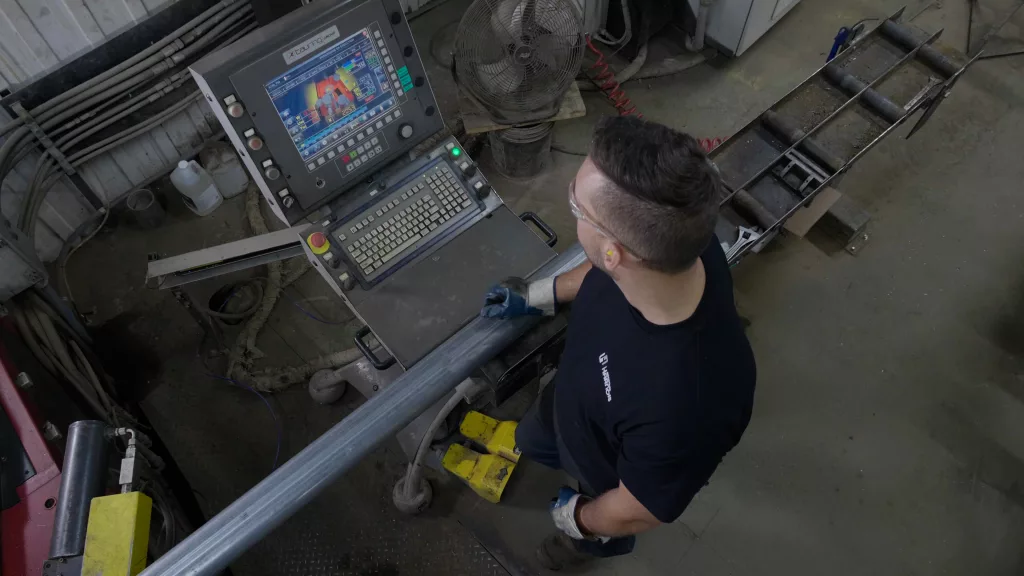
Commercial growers increasingly expect manufacturers to play an active role beyond the point of sale, particularly on projects with higher capital value. For instance, a large-scale greenhouse project designed to supply nationwide grocery chains often requires significant investment in customized automation and climate-control systems. In such scenarios, the expectation is that manufacturers will not only provide the infrastructure but also offer ongoing support to ensure these investments yield maximum productivity and return on investment.
During the pre-construction phase, this often includes support with permitting and compliance. While manufacturers are not responsible for approvals, growers value suppliers who provide engineered drawings, stamped plans, and documentation that aligns with local building authorities. Guidance based on prior experience with municipalities or regions can significantly reduce friction.
Greenhouse Manufacturer - Harnois
commercial greenhouse buying guide
On the financial side, manufacturers are not expected to secure funding, but they are often expected to support financing efforts indirectly. By aligning designs with energy-efficiency incentives, growers can unlock rebates that significantly reduce initial costs. Additionally, providing the technical documentation required for grant applications can streamline the qualification process and enable faster payback periods. Manufacturers can stay updated on regional incentives by subscribing to industry newsletters, joining relevant industry groups, and utilizing digital tools that track regulatory updates. Sharing insights from similar funded projects paints a clearer picture of potential financial upsides, making the investment more attractive from a bottom-line perspective. For example, a recent project in Ontario involved a greenhouse manufacturer aligning its design with local energy-efficiency programs, allowing the grower to receive a 20% rebate on initial installation costs. This not only reduced the upfront investment but also enhanced the project’s financial viability and attractiveness.
 
Post-sale support is equally critical. Commercial growers expect clear installation guidance, responsive technical assistance, access to replacement parts, and continuity over the lifespan of the structure. Long-term support reinforces the idea that the greenhouse is a durable asset, not a short-term product.
commercial greenhouse buying guide

Navigating Permits and Regulations

Grower priorities and regulatory expectations vary significantly across North America, and manufacturers who understand these differences are better positioned to succeed.

Canada

Canadian growers place strong emphasis on structural strength, snow load resistance, energy efficiency, and year-round production capability. Heating systems, insulation strategies, and energy curtains are often considered essential rather than optional. Regulatory requirements tend to be stringent, with detailed engineering documentation commonly required at the municipal or provincial level. Incentive programs related to energy efficiency or agricultural innovation frequently influence design decisions.

United States

The U.S. market is highly diverse, with priorities varying by region. Northern states share many of Canada’s concerns around snow load and heating, while southern and western states often prioritize ventilation, cooling, and heat management. Regulatory frameworks vary widely by state and municipality, making local experience particularly valuable. U.S. growers often focus on scalability, automation, and labor efficiency, especially for large multi-acre operations.

Mexico

In Mexico, grower priorities are strongly centered on heat management, ventilation, light optimization, and cost efficiency. Structures must perform reliably under high temperatures and intense solar exposure. Regulatory processes are generally less complex than in Canada or the U.S., but growers place high value on proven designs that maximize productivity while controlling costs. Automation adoption is growing, particularly for export-oriented operations, but systems must remain practical and easy to maintain.

Regional realities

 
Manufacturers who proactively adapt their recommendations to these regional realities are seen as more credible and better aligned with grower needs. To stay competitive, they must keep track of evolving regulations and incentives across different regions. Joining industry groups, such as the American Greenhouse Manufacturers Association, or platforms like the Global Greenhouse Resource Network, provides access to the latest trends and regulatory changes. Regular client feedback can also be a valuable resource for understanding regional demand. Additionally, using digital tools and platforms such as AgriSync and ProduceHQ that track regulatory updates can ensure manufacturers remain informed and responsive
commercial greenhouse buying guide

Integrating Technology and Automation
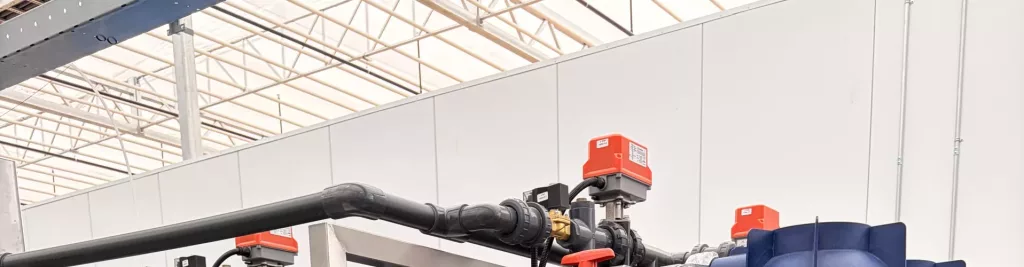
Commercial Greenhouse Buying Guide - greenhouse Automation and Technology
When it comes to technology, growers rarely want to over-invest upfront, but they do want future flexibility. Best-in-class manufacturers approach automation as a staged strategy rather than a fixed package.
 
This begins with designing the greenhouse structure to be automation-ready: sufficient height, load capacity, electrical planning, and space for future systems. From there, manufacturers should recommend core technologies that deliver immediate value, such as climate control, irrigation automation, and basic environmental monitoring, while ensuring compatibility with more advanced systems later.
Clear communication is critical. Growers value guidance on which technologies are essential at launch, which can be added later, and how each choice impacts labor, energy use, and production consistency. To enhance communication, manufacturers should provide detailed case studies or examples demonstrating successful technology implementations. Regular webinars or workshops can be organized to update growers on the latest advancements and how to integrate them into existing systems. It’s also beneficial to offer comprehensive written commercial greenhouse buying guides or video tutorials that cover installation, maintenance, and upgrade processes. Avoiding vendor lock-in and prioritizing interoperable systems further strengthens long-term trust.
 
Ultimately, the goal is to help growers invest in technology that grows with their operation rather than constraining it.

Building A Greenhouse? Don't Make These Mistakes!

In this week’s episode, JM Fortier reviews the installation process of his new Harnois greenhouse and shares 5 tips that he learned over the years to help you install a greenhouse on your farm. The installation of a greenhouse is an important project for the profitability of a farm. However, the learning curve for selecting the right infrastructure and equipment can be steep, and adapting to growing crops in a controlled environment can be a challenge.

Check out our course Mastering Greenhouse Production so you can avoid a lot of costly mistakes and run a successful greenhouse operation.

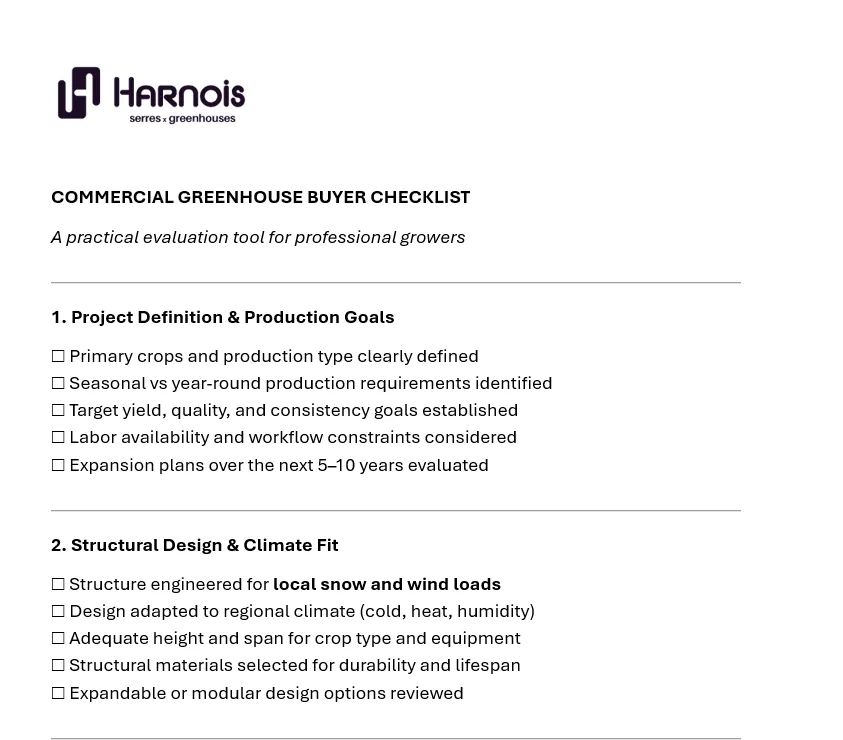
COMMERCIAL GREENHOUSE BUYER CHECKLIST

Selecting a commercial greenhouse is a long-term investment that affects production efficiency, operating costs, regulatory compliance, and business growth. Too often, decisions are made based on upfront price or surface-level specifications, without fully evaluating how a structure will perform over its entire lifespan or how well a manufacturer supports the project from design through operation.

This checklist is designed to help professional growers take a structured, objective approach when evaluating greenhouse projects and manufacturers. It highlights the key technical, operational, and strategic considerations that should be reviewed before committing to a purchase, including structural design, climate adaptation, automation readiness, permitting requirements, and long-term support.

Use this checklist, part of the commercial greenhouse buying guide, as a practical tool to compare options, guide discussions with manufacturers, and ensure that the greenhouse you choose is engineered not only to meet today’s needs, but to support future expansion, efficiency, and reliability.
commercial greenhouse buying guide
These expectations reflect a broader shift in the commercial greenhouse market. Growers are no longer looking for manufacturers who simply deliver a structure. They are looking for partners who understand regulation, climate, production economics, and long-term operational risk.
 
Manufacturers, such as Harnois, who meet these expectations differentiate themselves not just on price, but also on professionalism, credibility, and long-term value.